Insight Global
Consolidating five tools into one CRM recruiters actually wanted to use
Consolidating five tools into one CRM recruiters actually wanted to use

Role:
Product Designer → Design Lead
Team size:
9 people
Timeline:
8 months
Core tools:
Sketch · Zeplin
Overview
The problem
Recruiters and account managers ran their entire day across five disconnected tools. Acquiring requisitions, managing applicants, managing accounts, filling and closing roles, each lived somewhere different, and moving one requisition through its lifecycle meant re-entering the same information repeatedly and losing the thread between steps.
The cost wasn't only time. Recruiters and account managers work the same requisitions from different angles, but because their tools didn't overlap, coordination happened over messages rather than in a shared system. And with people frequently out at client sites, desktop-bound work waited until they were back.
Recruiters and account managers ran their entire day across five disconnected tools. Acquiring requisitions, managing applicants, managing accounts, filling and closing roles, each lived somewhere different, and moving one requisition through its lifecycle meant re-entering the same information repeatedly and losing the thread between steps.
The cost wasn't only time. Recruiters and account managers work the same requisitions from different angles, but because their tools didn't overlap, coordination happened over messages rather than in a shared system. And with people frequently out at client sites, desktop-bound work waited until they were back.
The solution
We designed a single CRM covering the full requisition lifecycle, built around the workflows employees already had rather than feature parity with the tools it replaced. Consolidating entry points meant the same information stopped being typed into five systems, which cut task time by 45% and data entry errors by 28%.
Recruiters and account managers now work the same records with role-based permissions, so handoffs that used to live in message threads happen in the product. Every view is responsive, built for someone checking a pipeline from a client's lobby. Five teams adopted it.
We designed a single CRM covering the full requisition lifecycle, built around the workflows employees already had rather than feature parity with the tools it replaced. Consolidating entry points meant the same information stopped being typed into five systems, which cut task time by 45% and data entry errors by 28%.
Recruiters and account managers now work the same records with role-based permissions, so handoffs that used to live in message threads happen in the product. Every view is responsive, built for someone checking a pipeline from a client's lobby. Five teams adopted it.
Key outcomes
28%
28%
Drop in data entry error rate
Drop in data entry error rate
4.6/5
4.6/5
User satisfaction score post-launch
User satisfaction score post-launch
5
5
teams adopted the unified platform
teams adopted the unified platform
28%
Drop in data entry error rate
4.6/5
User satisfaction score post-launch
5
teams adopted the unified platform
Research & discovery
Understanding the problem
We studied how employees actually worked, mapping the real path a requisition takes from intake to close across all five tools. Alongside that I ran twice-weekly design reviews with the client's product owner, UX designer, two subject-matter experts, and their COO and upper management. Those sessions worked as ongoing research as much as approval gates, since the product was for their own internal teams and the people reviewing it were the people who'd live in it.
We studied how employees actually worked, mapping the real path a requisition takes from intake to close across all five tools. Alongside that I ran twice-weekly design reviews with the client's product owner, UX designer, two subject-matter experts, and their COO and upper management. Those sessions worked as ongoing research as much as approval gates, since the product was for their own internal teams and the people reviewing it were the people who'd live in it.

Key findings
Workflow observation surfaced a gap between how the tools were organized and how the work actually happened. The five systems were each coherent on their own, but nobody's job matched the boundaries between them. Recruiters and account managers described the same frustrations from opposite sides of the same requisition, and both had built manual workarounds to compensate for a system that couldn't see the full picture.
Workflow observation surfaced a gap between how the tools were organized and how the work actually happened. The five systems were each coherent on their own, but nobody's job matched the boundaries between them. Recruiters and account managers described the same frustrations from opposite sides of the same requisition, and both had built manual workarounds to compensate for a system that couldn't see the full picture.
The cost of context and clicks
Every tool switch meant rebuilding context around where a requisition stood, what had already been tried, and what the account manager had promised the client. People weren't slow because the tools were slow. They were slow because nothing carried the thread from one step to the next.
One requisition, separate processes
Recruiters and account managers worked the same requisitions with different responsibilities and no common system to work in. Coordination happened over messages, which meant status was always slightly out of date and the same questions got asked repeatedly.
The cost of context and clicks
Every tool switch meant rebuilding context around where a requisition stood, what had already been tried, and what the account manager had promised the client. People weren't slow because the tools were slow. They were slow because nothing carried the thread from one step to the next.
One requisition, separate processes
Recruiters and account managers worked the same requisitions with different responsibilities and no common system to work in. Coordination happened over messages, which meant status was always slightly out of date and the same questions got asked repeatedly.
Design process
Starting off on the right foot
I worked alongside a principal designer who went on maternity leave partway through, and I carried the work to completion from there. Each feature started from the current-state workflow. I'd map what a task looked like across the existing tools, then design the version that collapsed it into one. Twice-weekly design reviews walked stakeholders through both the flow they knew and the flow replacing it, which made the case for each change concrete instead of abstract.
I designed in Sketch and handed off through Zeplin, working directly with the client's two developers on interaction and responsive questions as they built. Alongside the product I delivered a full design system reflecting their updated branding.
I worked alongside a principal designer who went on maternity leave partway through, and I carried the work to completion from there. Each feature started from the current-state workflow. I'd map what a task looked like across the existing tools, then design the version that collapsed it into one. Twice-weekly design reviews walked stakeholders through both the flow they knew and the flow replacing it, which made the case for each change concrete instead of abstract.
I designed in Sketch and handed off through Zeplin, working directly with the client's two developers on interaction and responsive questions as they built. Alongside the product I delivered a full design system reflecting their updated branding.
Design solutions
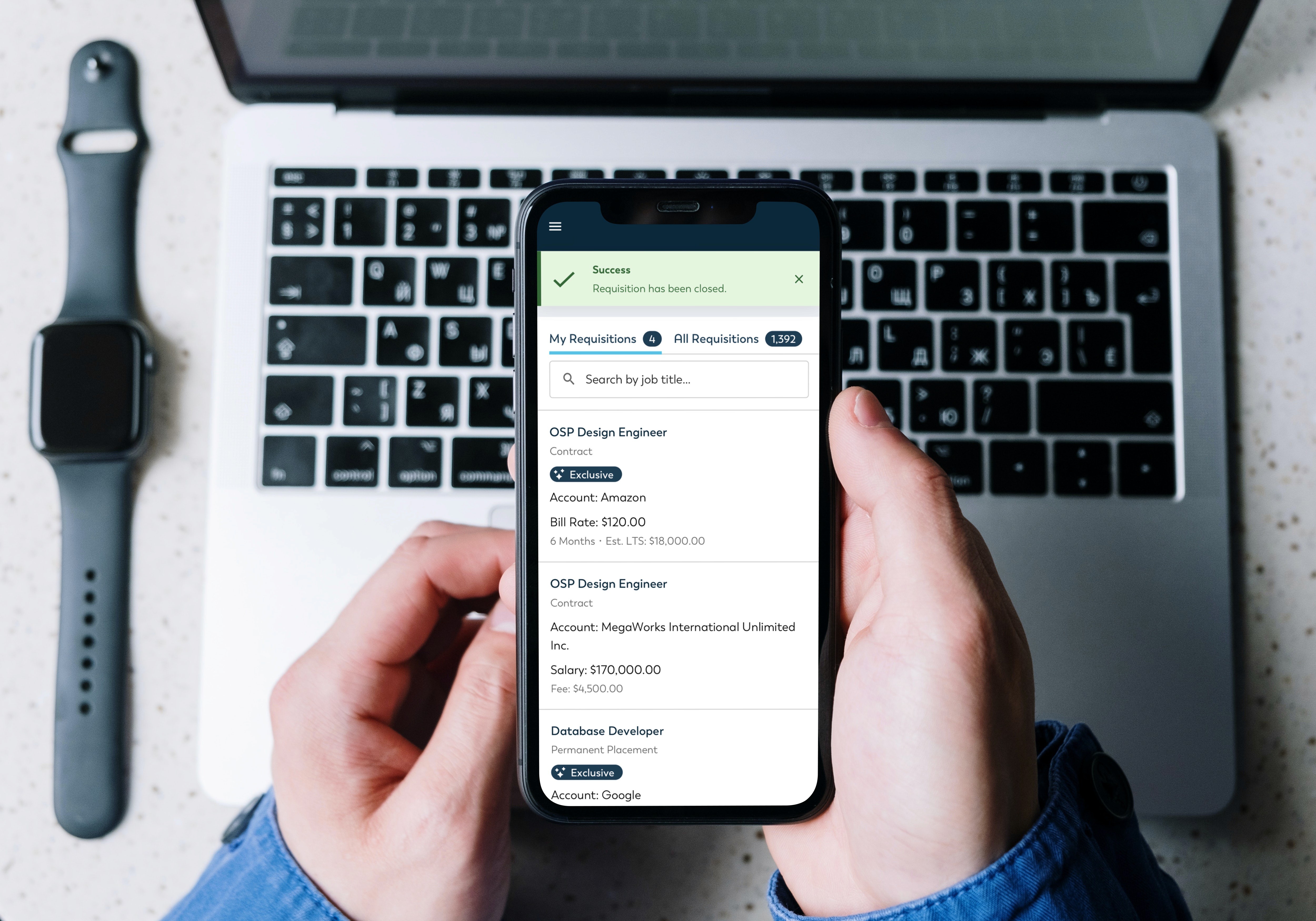
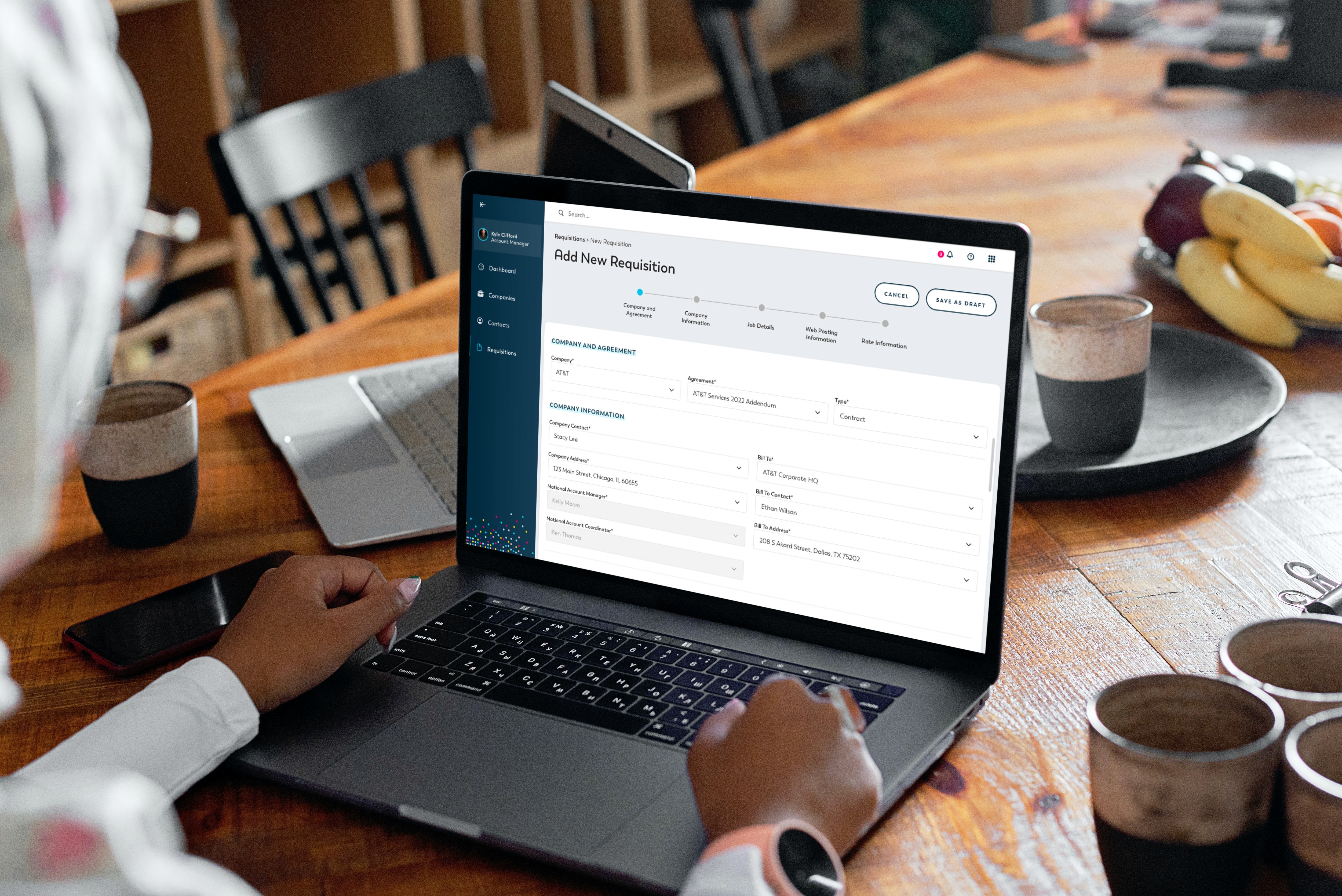
The CRM covers the full requisition lifecycle in one place, including intake, applicant management, account management, and closing. Role-based permissions let recruiters and account managers work the same records with different capabilities, so coordination lives in the product instead of in messages. Every view is responsive, built for someone checking a candidate pipeline from a client's lobby.
The design system carries their brand into the product. They use bright colors and confetti as part of their identity, and applying that to a tool people sit in all day keeps it feeling like it belongs to them.
Adoption was the real risk, so the system was designed to sit inside existing habits instead of replacing them. Testing confirmed it. Users completed tasks faster and described the tool as simple and easy to learn without disrupting their day-to-day. We also trained the client's UX team on the system and its patterns so they could keep supporting and extending it after we rolled off.
The CRM covers the full requisition lifecycle in one place, including intake, applicant management, account management, and closing. Role-based permissions let recruiters and account managers work the same records with different capabilities, so coordination lives in the product instead of in messages. Every view is responsive, built for someone checking a candidate pipeline from a client's lobby.
The design system carries their brand into the product. They use bright colors and confetti as part of their identity, and applying that to a tool people sit in all day keeps it feeling like it belongs to them.
Adoption was the real risk, so the system was designed to sit inside existing habits instead of replacing them. Testing confirmed it. Users completed tasks faster and described the tool as simple and easy to learn without disrupting their day-to-day. We also trained the client's UX team on the system and its patterns so they could keep supporting and extending it after we rolled off.

Impact
Reflection
The hardest part of this project wasn't designing the tool, it was earning the switch. Consolidating five tools means asking people to give up workarounds they've spent years perfecting, and a better system on paper loses to a familiar one in practice. Showing stakeholders their current flow next to the new one in every review did more for buy-in than any polished prototype would have.
Taking the project over partway through taught me something too. Continuity mattered more than authorship. The value was in preserving the reasoning behind decisions already made rather than re-deciding them.
The hardest part of this project wasn't designing the tool, it was earning the switch. Consolidating five tools means asking people to give up workarounds they've spent years perfecting, and a better system on paper loses to a familiar one in practice. Showing stakeholders their current flow next to the new one in every review did more for buy-in than any polished prototype would have.
Taking the project over partway through taught me something too. Continuity mattered more than authorship. The value was in preserving the reasoning behind decisions already made rather than re-deciding them.